

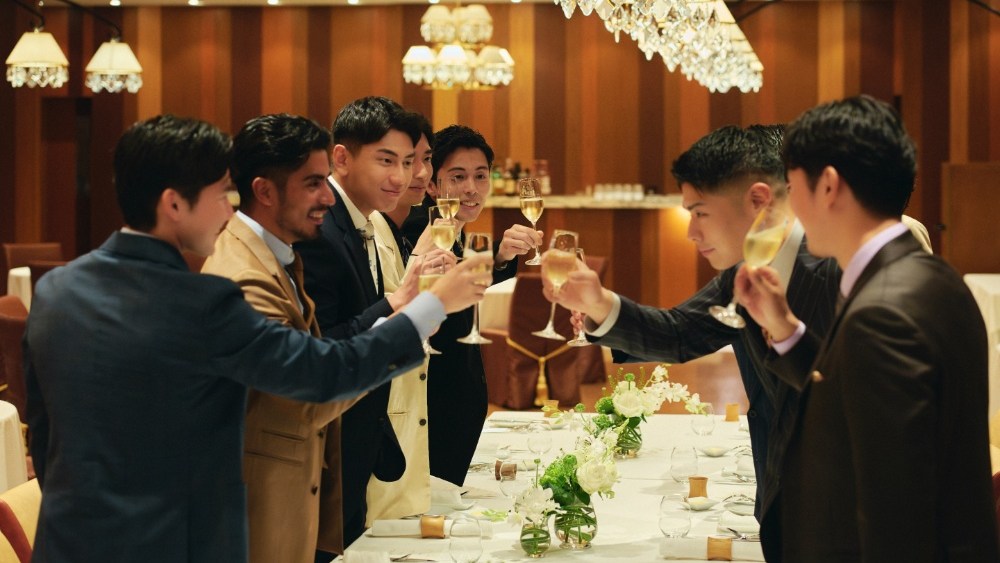
The huge success of LGBTQ+ dating series “The Boyfriend” has further boosted the reputation of Netflix’s Japanese unscripted division, and Dai Ota, head of the streamer’s Japanese unscripted division, attributes the unexpected international response to a deliberate rejection of the traditional reality TV formula.
The expanded slate includes the renewed series “Badly In Love,” which ranked 8th on Netflix’s Global Top 10 Non-English Series list, as well as the new series “Final Draft,” Japan’s first physical survival series, and “Offline Love,” which completely eliminates the phone from the dating equation.
“The thing I’m most conscious of is not incorporating elements like big games or a strong overarching plot,” Ota told Variety. “Once I set up the basic environment, I try to just watch and let the participants be themselves.”
That philosophy extends to a variety of titles, including Badly In Love, which focuses on Yankee culture, and Love Village, Japan’s first reality show for contestants aged 35 to 60, currently in its second season. Ota believes this approach is meant to avoid what he calls the variety show convention of turning people into expendable character symbols.
“Once you label someone as a “joking bastard,” “a hopeless person,” or a “love master,” that person’s story becomes fixed,” Ota explains. “We purposely selected people who are difficult to label because they have multilayered identities, including age, gender, background, and romantic experience, and followed them over time.”
This strategy has proven particularly effective with international audiences. “Badly In Love” created a huge buzz on social media within hours of its release, reaching the top 10 in South Korea, Singapore, Hong Kong, and Taiwan, despite featuring a very local subculture. “What surprised me was that overseas viewers, who are probably not familiar with Japan’s Yankee subculture, were excited by the characters’ emotions at about the same point as Japanese viewers,” says Ota. “We were able to confirm that outlaws and people on the margins of society can seriously face their past, and that clumsy expressions of love can be seen as universal.”
This breakthrough confirms Netflix’s “local for local, global for global” philosophy. Rather than diluting certain cultural elements, Ota argues that maintaining local intensity while creating accessible entry points through subtitles and editing allows for authentic engagement. “There’s no need to dilute or overemphasize certain cultures or personalities to create a global version,” he says. “By keeping the local intensity intact and portraying things honestly, while also carefully creating an accessible entry point, we can gain confidence that audiences around the world will be happy to jump in.”
Set in Hokkaido, Season 2 of “The Boyfriend” doubled the length of their cohabitation from one month to two, demonstrating how an extended timeline can create space for relationship complexities that Season 1 fails to capture. “We were able to see developments that were not present in season 1, such as people ending one love and moving on to another, and couples forming and then graduating midway through,” Ota says.
The cast reflected on how the expanded format has reshaped their understanding of relationships. Bomi, 23, joined the site in search of her first boyfriend, but found herself questioning her ideal concept. “I only looked on the bright side of love,” he says. “In the process of growing love, you may find yourself fighting or having problems in your relationship. Those are things I never imagined. Love is more than just loving each other. That in itself cannot sustain a relationship.”
For 32-year-old Izaya, facing his past relationship patterns was transformative. His previous long-term relationship taught him a hard lesson in communication. “We tried to hide things. We got so deep into the relationship that we hid some of the things we couldn’t say,” he recalls. “From now on, I want to be able to face the other person, communicate with them, and say what I think.”
Studio host Dorian Lollobrigida, who returned to the studio with Megumi, Yoshimi Tokui, Chiaki Horan, and Thelma Aoyama, talks about his role as an interpreter and representative of the audience. “Basically, we’re just like one of the viewers, following the boys’ drama and having fun,” Dorian explains. The extended timeline created an opportunity for more nuanced depictions. “The longer the show, the more time we have to face each other and spend time together. Compared to season 1, people’s feelings are portrayed in more detail.”
Ota continues to focus on balancing emotional authenticity with participant well-being. “Our rule is not to introduce game-like elements or impose a forced overall structure that goes against the participants’ true feelings,” he says. “The only way to make a real reality show is for people to be themselves, to be themselves, and to keep filming for as long as possible.”
Mental health support is provided throughout production and aftercare is explained in advance. “I believe that delivering excitement to viewers and protecting the lives and health of cast members must always be considered together,” Ota emphasizes.
Looking ahead, Dorian hopes to expand his expressiveness in future seasons. “I want a more feminine, feminine type of person (called one in Japanese), but I also want people with different body types and different backgrounds. I wish there was more of a range.”
Ota measures success in multiple dimensions, not just viewership data. “What I personally care about is how many people watch this work all the way to the end and love it, and how many people it continues to influence and how deeply it continues to influence them even after it ends,” he says. “Even if the numbers aren’t huge, if I can hear a response from viewers who say, “This program gave me food for my life,” or “It saved my soul,” I would consider that a success.”
