

Forty years from now, in 2075, extreme weather conditions will force humanity to live, at least in part, inside a protective dome. Most jobs, from road construction to police work, will be outsourced to robots. In addition, jobs that were once thought to require a human touch, such as education and child care, will likely be performed by humanoid machines in the future. At least that’s how French director Hugo Bienvenue envisions it with his debut feature Arco, which is currently nominated for an Oscar for Best Animated Feature.
Despite such gloomy predictions, “Arco” is a sharp and wonderful sci-fi adventure about two children in two different eras that ultimately offers hope about the future of humanity. Bienvenu’s hand-drawn characters fall somewhere between the gritty realism you’d expect from mature graphic novels and comics and the cartoonish look of certain anime. The gorgeously detailed backgrounds are one of the strongest pieces of evidence of Hayao Miyazaki’s notable influence on the French animator and illustrator. This is because both timelines of Arco take place in environments where nature is prominent. That alone distinguishes Bienvenue’s futuristic take on reality from most science fiction stories, which often take place in a sophisticated cold laboratory, a desolate planet, or a complex spaceship floating in the vastness of space.
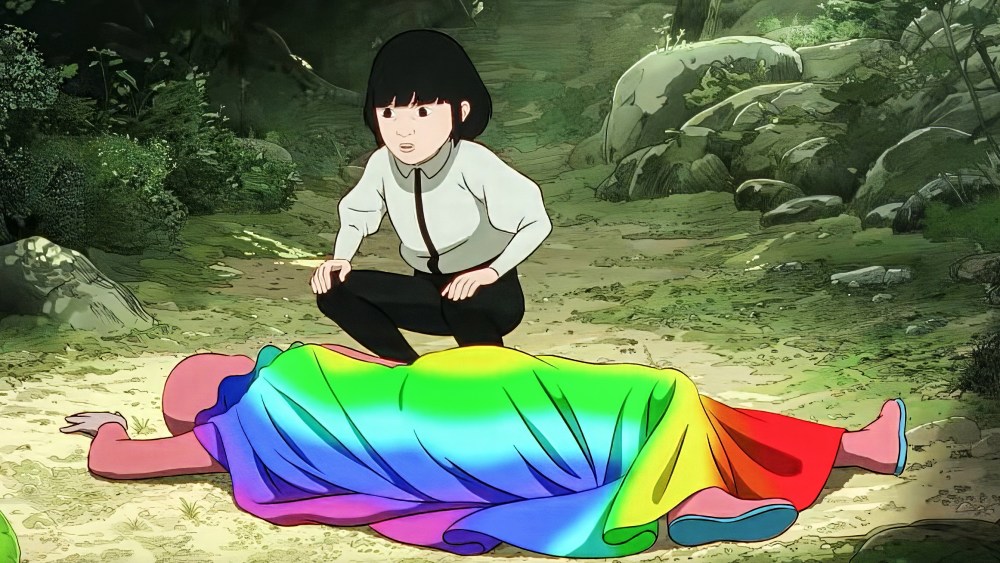
The version of Earth inhabited by 10-year-old Arco (Giuliano Crewe Valdi) features houses built on platforms built on giant beams. Humans live above the clouds and seem to have returned to a more minimalist lifestyle after the disaster. Still, children will always be children, and in order to fulfill his wish to see real dinosaurs, Arco disobeys his parents. He steals a rainbow-colored flying cloak that allows people to time travel, and accidentally lands in the aforementioned robot-driven year 2075 AD. Arnaud Toulon’s epic score pushes “Arco” into the realm of an Amblin film, especially in the flying scenes.
There, Arco finds a curious ally in Iris (Romy Faye), a girl of the same age but with different experiences growing up. Arko’s parents are physically present in his life, but Iris is away on business and can only interact with their holograms. Instead, Iris and her younger brother Peter are cared for by a robot nanny named Mickey (the actors also play Iris’ parents, whose voices are a combination of those of Natalie Portman and Mark Ruffalo). From this point on, the plot of the film is simple. Arko must find the crystal he lost during his crash landing in order to make his colorful cloak work and return to his time. But an environmental disaster and a trio of eccentric minions (voiced by Will Ferrell, Flea, and Andy Samberg) get in the way.
Curiosity about each other’s world governs Arco and Iris’ relationship. She is surprised to learn that robots like Mickey no longer exist in his time or her future, and is jealous that her parents are not able to discipline her. The exchange between these two futures yields great revelations about the conclusion, but also brings into view the artificiality of the present we are dangerously close to. 2075 feels inhuman. Most adults in Iris’ town wear visors over their eyes, implying that although their bodies are there, their minds are elsewhere in the virtual environment. In the scene where Arco, Iris, and the friends they pick up along the way invade her school, we see a classroom where holograms bring the past to life, including dinosaurs, but it’s all an illusion. Still, Mickey’s fearless nature in trying to protect Iris at all costs seems to go beyond what robots are programmed to do. Even if that emotional connection is learned, it feels sincere.
Bienvenue takes children seriously, not only in that it explores children’s expectations and opposition to their relationships with their parents and the rules they must follow, but also because it does not absolve children of responsibility for their choices. The two children in “Arco” learn that there are irreversible consequences to putting yourself at risk. The trade-off is less time to spend with loved ones, something we can never get back. The thematic maturity seen here and in another Oscar-nominated French animated film, Little Amelie, or Character of the Rain, is something lacking in most American studio films. Rather than infantilizing the targeted young audience, there is a conscious effort to address difficult turning points in life.
“Arco” looks fantastic and recognizable, yet far enough away from what we currently know, yet grounded in a familiar childlike sense of wonder. Bienvenue refuses to get hung up on time travel technology, holograms, or the mechanics of protective domes. As events occur, one comes to understand the era of Iris. And while it’s clear that this is a cautionary tale, Bienvenue offers the concept of a potentially brighter tomorrow as much as dark destruction. There’s no denying that our planet is in crisis, but what if this is an opportunity for renewal? It’s a refreshing prospect to believe in.
