

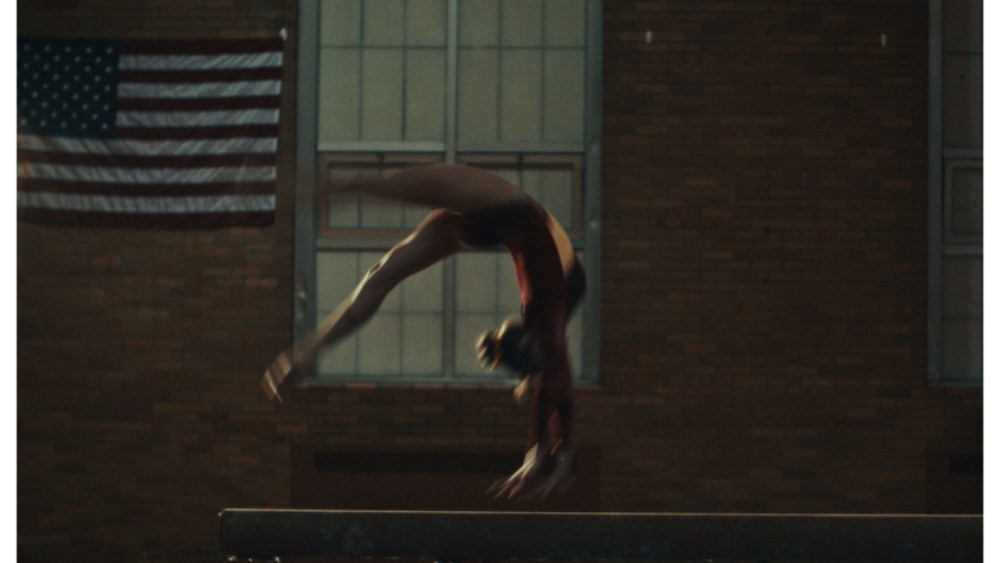
Set in Pittsburgh in the early 1990s, “The Gymnast” follows a young athlete who, like his city, loses his identity after a life-altering accident. But director Charlotte Glynn, who also grew up there, saw modern parallels in the story.
“A ton of people were leaving Pittsburgh looking for work. The whole town became a ghost town,” she recalled, describing the aftermath of the 1980s steel crisis.
“Thousands of people will be laid off, and the effects of industrialization may be linked to the current fascism in the United States. It is not so fanciful to link the destruction of these communities to the rise of enemies of their neighbors.”
She added: “The best period pieces reflect exactly what’s happening right now.”
Despite the personal elements, Glynn wanted to address “bigger questions” in the film. “Something outside of my own personal anxieties. I want to turn my experience into something that other people can work on.”
Her main character, 16-year-old Monica (Brittany Wheeler), dreams of competing in the Olympics. Instead, the accident causes her to rethink her entire future.
The film was produced by Ricky Tolman and Luke Spears and premiered at the Tiger Competition in Rotterdam, with Visit Films handling sales.
“When we were teenagers, we had a close friend who was a gymnast, and we saw her go through something similar. It just changes your life,” she says.
“Disability is something I’ve explored in my previous films. My sister has an intellectual disability, and being deeply involved in making ‘The Gymnast’ made me realize that this is more than just a sports movie. This movie is about how we can lose the physical things that we take for granted.”
When it comes to subverting genre, she thinks of films like Chloé Zhao’s The Rider and The Wrestler. These films also portrayed former athletes battling injuries and age.
“I feel like ‘gymnast’ is part of this tradition, but that identity is still part of who Monica is. A friend who inspired me still knew her floor routine at age 30. I wondered: What does it mean to live your whole life connected to something like this?”
Wheeler, an athlete himself, has been involved with the film for a long time.
“We started casting before the pandemic, so we met her when she was 12 years old. She had this incredible ability to just be there. We didn’t start filming until four years later, so we ended up making the character older.”
Ethan Embry joins the cast as Rich, the irresponsible but loving father of the adrift Monica. This is partly because his generation, unlike his parents, cannot find stable work in steel mills.
“Do you think we are kinder to fathers than mothers?” wonders Glynn.
“I didn’t intend to dislike any of the characters, but I could see people empathizing with him just because he was ‘trying.’ “Even if he couldn’t see what was right in front of him,” she said.
“Ethan brought a lot of vulnerability[to the role]but he was also a child actor. We wanted to cast someone who was comfortable working with young people who had never been on set before.”
Monica’s injury forces her to break away from her strict schedule and established routine, and she begins to experiment.
“She’s suddenly isolated because of her injury and she’s looking for connection. I really wanted to explore her rebelliousness and the excitement of, say, drinking in the park,” Glynn says.
“For me, high school was the worst. It’s a very complicated time and I’m trying to figure out who I am. But I’m also open to all these new experiences. I’m just as excited when she’s running from the police as when I was still competing.”
But her transformation won’t be easy.
“Being a teenager is really complicated. Being a teenage girl is really complicated. You’re dealing with hardships, but you’re also … having this thrill. When I was younger, all I wanted to do was get out of Pittsburgh. So I was looking for adventure until I finally got out. And I did.”
After “The Gymnast,” Glynn is excited to finally let go of the past.
“I just went to Pittsburgh for Thanksgiving, and it was just an incredible feeling. I spent 20 years there, and now it’s like it’s released from me. Now I can go to Pittsburgh and keep making other movies, and I can tell other stories.”
