

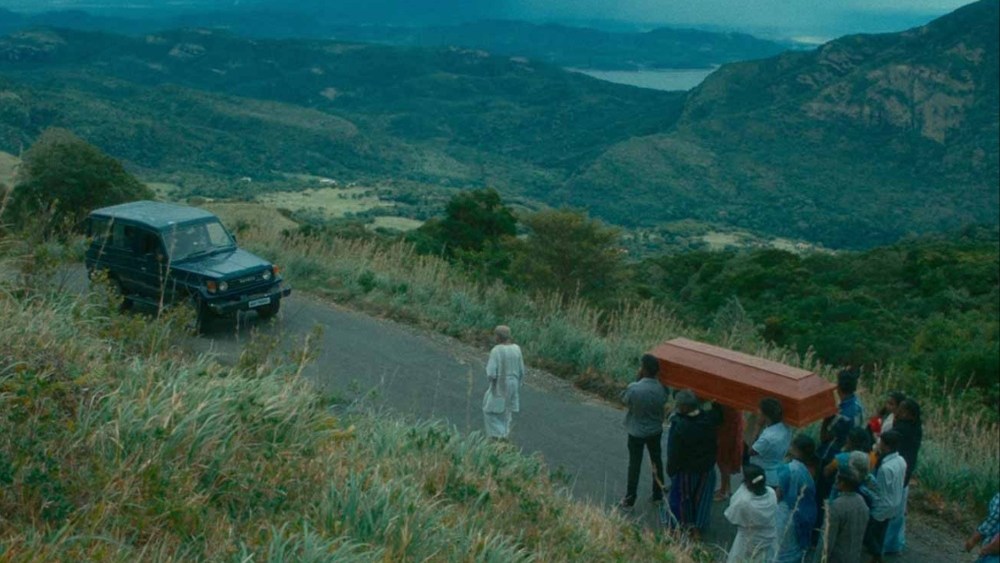
Sri Lankan director Lalith Rathnayake’s “Riverstone” has won the top award, the Golden Cyclo, at the 32nd Vezure International Asian Film Festival. The festival concluded on February 3rd after a week of screenings of Asian films in the French town.
The international jury, headed by Chinese director Wang Bing and consisting of South Korean director Shin Su-won, Iranian producer Katayoun Shahavi, and French director/producer/screenwriter Joel Farges, highly praised the film, which examines the political crisis in Asia and its impact on ordinary people. The drama reflected “the current state of affairs on the continent” and showed how “a deep crisis of political power in Asia threatens the survival of ordinary people,” the jury said.
The jury praised the acting, noting that director Rathnayake had “perfectly expressed the humanistic spirit” of the adaptation, and cited the film’s “sharp critique of contemporary politics” as a factor in its victory. The film previously won top awards at film festivals in Shanghai and Singapore.
Wang Bing also received the festival’s honorary Golden Cyclo from the Vusoul Urban Community and Vusoul City.
Kyrgyzstan’s “Crack,” co-directed by Elke Zhumakhmatova and Emil Atagerdiyev, won the Grand Jury Prize for what the jury described as “thematic importance and universality.” The judges praised the film as “achieving in every cinematic way,” emphasizing both acting and direction. Atagerdiev died in 2024. “Crack” won the top award in Busan last year.
“Before the Bright Day,” directed by Taiwanese film director Cao Shee-han, won the Jury Prize and also won the Netpac Jury Prize. The film is set in a middle-class family in Taiwan facing economic hardship, and follows a young boy who grows up in an abusive home, struggles to survive in school, and overcomes the horrors of war and violence. The jury noted the director’s deft contrast between stillness and movement, with the protagonist “frozen” inside the violent house but “in constant motion” outside, as if trying to escape a world of conflict.
Netpac’s jury, led by Indian festival programmer Raman Chawla, praised the film for its “sophisticated blend of historical scale and domestic drama, straddling the gap between national crisis and personal growth with cinematic precision and heart.”
The international jury also awarded two special awards. Firstly, Iranian filmmaker Abbas Nezamdoost’s “Duality” received a special award for its original cinematic approach, and secondly, Thai director Nawapol Tamrongrattanarit’s Venice Prize-winning “Human Resource” received a special award for its direction.
“Human Resource” won the Mark Hertz Jury Award. The unanimous jury decision acknowledged the film’s exploration of pregnancy and bodily autonomy, noting its “understated narration, subtle acting, and precise and rigorous visual and sound design.” The panel discussion highlighted the film’s central question: how an “ordinary woman” who experiences pregnancy becomes “a social body, subject to the gaze, judgment, and domination of others.”
Kurak also received the Critics Jury Award, with the jury citing the filmmaker’s “courage in tackling painful current events in a sensitive manner.” “Riverstone” received a special award from the same jury for its psychological exploration of justice and conscience, supported by strong lead performances and cinematography.
The Friends of Emile Guimet award went to Riverstone, with the jury praising it as a road trip film about the conflict between an empathetic prisoner and three police officers that expressed “the reversed duality of good and evil”. The jury noted the unexpected pacing and cinematography. Indian director Tanishtha Chatterjee’s “Full Plate” received a special award from the same jury for its portrayal of women’s lives in India’s diverse social and religious backgrounds, and the panel highlighted the film’s depiction of sisterhood and hope.
“Full Plate” also won the Public’s Choice Award for Best Feature Film. The documentary award went to the French film “Li Chevalier, Encre et Âme” directed by Bernard Lehargan.
In the youth category, “Kurak” won the High School Jury Award, and “Hassan,” directed by Palestinian filmmaker Alaa Damo, won the Youth Jury Award.
The 33rd edition of the festival is scheduled to take place from February 2nd to 9th, 2027.
