

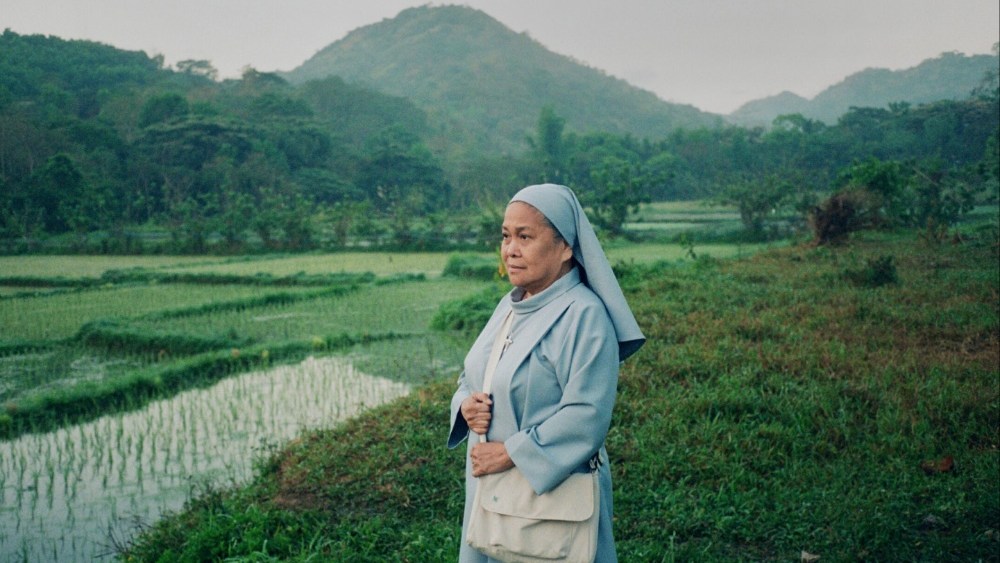
Filipino-Australian director James J. Robinson will present his debut feature film “First Light” at the Rotterdam International Film Festival. The drama therefore explores the intersection of faith, colonialism, and institutional corruption through the story of an elderly nun who grapples with moral issues in the Philippines. Variety has exclusive access to clips from the film.
The film, which had its world premiere at the 2025 Melbourne International Film Festival, stars Ruby Lewis as Sister Yolanda, a nurse and nun whose quiet life of service is upended when a young construction worker dies under suspicious circumstances. The incident forces her to reflect on the church and community she has served for decades.
Robinson explains that his approach to the material comes from personal experience. “Although I was raised Catholic, I knew from an early age that I was queer, which led me to question my initiation into Catholicism and take a different path,” he says.
This early interrogation experience set Robinson on a different spiritual trajectory than many Catholics. “I was very anti-Catholic at one time. I was very angry at the church, which had instilled in me a lot of beliefs about sin,” he says. “And I was able to graduate and realize that there’s a difference between an actual beautiful religion at the heart of something and an organization or a politician who can embrace that beauty.”
This film came at an unexpected and visionary moment. Written and produced before widespread anti-corruption protests erupted in the Philippines in 2025, First Light deals specifically with government funds that line the pockets of wealthy construction families. This is the very issue that has sparked nationwide demonstrations over poorly managed flood infrastructure projects.
“The great thing is that while we were making this film, the world was moving forward, and the things I was commenting on were also changing,” Robinson says. “But then when the corruption protests started, I was like, oh, this movie has become even more relevant. It was sad that the protests had gotten to the point where they had to happen, but there was so much beauty in the resistance and standing up.”
The director points out that the film was also made around the time that the International Criminal Court arrested former Philippine President Rodrigo Duterte for his war on drugs. “I would say that what we write is always relevant to Philippine history,” Robinson says. “They were relevant in the days of colonization, and they are still relevant today.”
The director was careful to avoid didacticism when tackling such political content, choosing instead to focus on personal stories rather than political controversy. “There were ways to make this film that would have been very essay-like,” he says. “The reason I want to make films is because I can understand grand themes through concrete stories and experiences.”
The director sees Sister Yolanda’s story as a metaphor for Philippine history itself. “I follow her journey from her farmland to institutionalization when she was young, and then where she ends up is a very Filipino story,” he says.
Robinson worked extensively with Luis, a veteran Filipino actor known for films such as “Isca,” “Marosa,” and the Prime Video series “Expats,” to develop Yolanda’s largely internal acting. Luis also works as an acting coach training young Filipino performers and brought significant expertise to this collaboration.
Although the director describes Yolanda’s calmness as a “quiet strength,” there is only one scene in which the character truly breaks down — when she returns to her childhood farm and encounters what appears to be the spirits of the land. “This is the only time in the movie where she actually expresses emotion. She really, really expresses emotion and she cries and lets it out,” Robinson says. “I wanted to make that experience and that scene as strong as possible so that she was always surrounded by strong moments.”
The production itself reflected the film’s decolonization themes, with Robinson and his team making careful choices about how Australian funds were spent in the Philippines. “We’re making this film about the history of colonization and how it continues to resonate today,” Robinson explains. “We can’t bring Australian money into the Philippines and pay people poorly or take advantage of lax labor laws. We’re only going to make this film if we can pay people properly, give them decent working hours, and do everything we can to use that money positively.”
Robinson sees the legacy of colonization permeating contemporary Philippine society. His own family history illustrates this point. His great-grandfather participated in the Philippine-American War in the early 20th century as a revolutionary against colonization. However, Robinson observes how American cultural influences lingered in her mother’s generation.
“To this day, my mother always believes that American products are the best in the world, just like Coke is the best, American food is the best,” he says. “This continued penetration of colonialism into everyday Philippine society, and the fact that the Philippines remains to this day the most Catholic country in all of Asia, is sadly just one example of how colonization severed ties with pre-colonial ways of thinking about the earth and planet, and with older indigenous knowledge systems.”
Shot in the Ilocos and Calabarzon regions of the Philippines, the film’s visual language was shaped by Robinson’s extensive research into indigenous Philippine knowledge systems and time spent in ancestral territory. The director wrote the first draft before visiting several locations and then spent a lot of time in the area during development.
That immersion led to one of the film’s most important lines, when Yolanda speaks about death. “She says death is like rain falling back into the ocean,” Robinson says. “That was the image I had when I was there. A lot of the indigenous knowledge systems that were destroyed when the Spaniards came and tried to impose this hegemony over everything were just knowledge and wisdom that came from the earth.”
Robinson’s previous work includes the 35mm documentary short “Inang Manila,” which detailed a personal investigation of his mother’s youth during martial law in the Philippines, and was obtained by Nownes.
First Light is produced by Gabriel Pearson and Jane Pe Aguirre of Majella Productions, with Christel Lou Dichanco serving as co-producer. Executive producers are Nick Batzias and Virginia Whitwell. The cast also includes Carissa “Kare” Adair, Maricel Soriano, Soliman Cruz, Emmanuel Santos, Rez Cortés, and Kidrat Tahimik.
Independent Entertainment will handle international sales.
Watch the clip here:
