

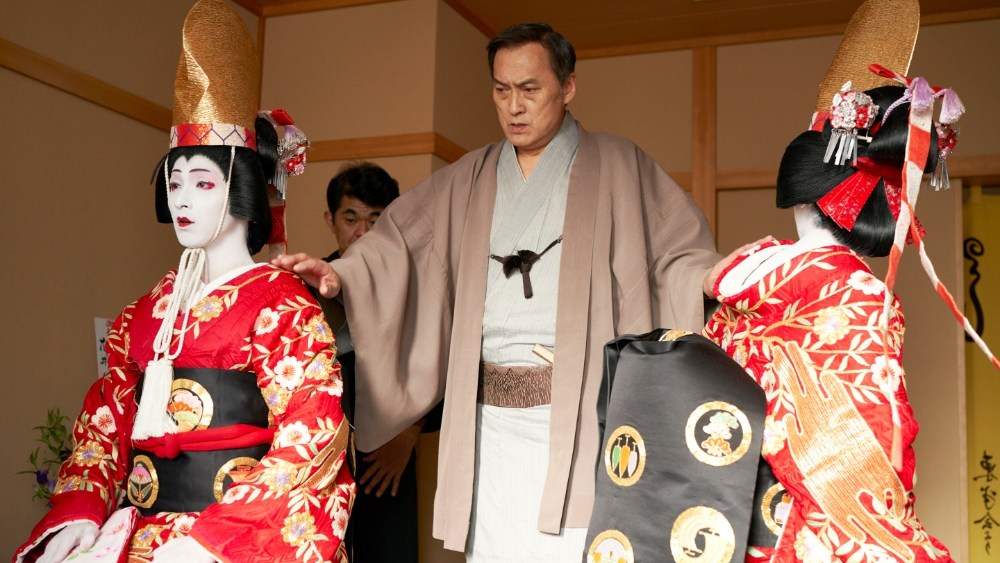
A nearly three-hour film about Kabuki, it was never supposed to be a huge box office hit, but Kokuho defied expectations and became Japan’s top live-action hit, as well as being nominated for an Oscar for Best International Feature.
The drama, directed by Lee Sang-il and starring Ken Watanabe, centers on kabuki, a traditional art form long considered commercially difficult, but it resonates deeply with Japanese audiences and is gaining attention overseas.
The story is set in Nagasaki in 1964, where 14-year-old Kikuo (Ryo Yoshizawa) is taken in by the famous kabuki actor Hanjiro (Watanabe) after his yakuza father dies. Together with his actor son Shunsuke (Yokohama Ryusei), Kikuo devotes himself to the centuries-old tradition of theater, and their relationship develops over decades of performances, from acting school to prestigious stages, against a backdrop of scandal and glory, brotherly love and betrayal.
Lee says this recognition carries far more weight than the momentum of the award. “This film deals with Kabuki, a traditional Japanese performing art, and it is a work that has received tremendous support from Japanese audiences.” “I feel it’s very meaningful for a film like this to be shortlisted for an Oscar, not just for Japanese cinema, but for Japanese audiences.”
Mr. Watanabe can’t hide his surprise at the popularity of this movie. “It’s not a samurai movie, it’s not a geisha movie,” he says. “Kabuki itself is difficult for even Japanese people to understand. Therefore, it is truly surprising and very gratifying that a film based on Kabuki has been accepted as part of Japanese culture by audiences around the world.”
Neither Lee nor Watanabe expected the film to be such a success locally. Lee points out that kabuki is no longer a mass-participant art form in Japan. “I didn’t expect this reaction,” he says. “But somewhere within the Japanese audience there is an underlying understanding that this is an important cultural tradition, and this film was able to connect well with that.”
Importantly, Lee emphasizes that its appeal goes beyond kabuki itself. “This is not just about kabuki,” he says. “This is a story about people who dedicate their entire lives to an art form. That kind of life, pursuing something at personal cost, is something audiences can relate to.”
Watanabe echoed that sentiment, describing the film as a story of artistic endeavor. “It’s about an artist giving their all to their art,” he says. “Life can be tough, but there is beauty within that harshness. I think people who feel anxious or uncertain about the future will be able to feel something in the characters who devote themselves fully to one thing.”
Lee also pointed out that the film’s visual approach is central to its reach, citing cinematography, direction, and production design. “I pursued beauty in every element, including photography, art, and make-up,” he says. “However, the very act of sacrificing everything and striving for greater heights is both cruel and beautiful. This idea seems to have resonated with young viewers and overseas viewers.”
Director Lee summed up the spirit of the film, adding, “This film is a pursuit of beauty.”
The film’s success comes amid broader global attention to Japanese culture, from anime and manga to renewed interest in live-action films. Watanabe points out that one long-standing barrier has been eased. “Language used to be a big hurdle for live-action films,” he says. “Since COVID-19, audiences have become more comfortable watching subtitled films and sharing their work has become easier.”
Lee added that the “national law” was never conceived as something calculated to gain international recognition. “We didn’t make this film targeting an international audience,” he says. “We looked to our own society and history: kabuki, female role traditions, family relationships, and the lives of artists. These are elements that are uniquely Japanese, but they exist alongside themes that are very universal. When they come together, it creates the potential for the film to travel.”
Looking back, Lee started the project with great skepticism. “From the planning stage, this wasn’t a movie that had high expectations,” he says. “It was Kabuki. It was nearly three hours long, the budget was high, and even Ken told me that I shouldn’t do it.”
“But even after its release, we continued to overcome all obstacles,” Lee added.
He compares the trajectory of a film to a living thing. “If this movie were about a child, it would be a movie with an incredibly strong soul that grows step by step. We are all watching with anticipation to see how far this movie, which bears the fate of its title, will be able to take,” says director Lee.
Oscar nominations will be announced on January 22nd.
