

Jack Fisk directed some of the most distinctive films of the past 30 years, from David Lynch’s Mulholland Drive to Paul Thomas Anderson’s There Will Be Blood. For Josh Safdie’s Marty Supreme, Fisk used his years of experience working with writers to create a vast world of 1950s New York in which Timothée Chalamet lives as the scheming table tennis champion Marty Moser.
The three-time Oscar-nominated production designer, who just turned 80, is probably the only person on the crew who remembers what the city looked like back then. But Fisk said Safdie was just as obsessed with getting things right, even extending to finding the right size ping pong balls, since ping pong balls in the 1950s were slightly smaller than today’s ones.
“Josh has so much energy and he loves New York so much. I was always looking for things I could tell him that were a little different, but he was way ahead of me,” Fisk says.
Working with the likes of Terrence Malick, Brian De Palma and Martin Scorsese, Fisk says, “It was an exciting time. I thought maybe we were going to take over the movie business. And now, this was exciting to me because there’s a whole new wave of great young filmmakers coming.”
“Marty Supreme” takes place in a variety of settings, from New York’s Lower East Side, a 1950s-era neighborhood full of street vendors and small shops, to Japan, where the crew spent two weeks preparing and filming.
Locations include New York’s Plaza Hotel, which replaced London’s luxury hotels, the Indonesian Embassy, and the Woolworth mansion on East 80th Street, home to wealthy characters such as Gwyneth Paltrow and Kevin O’Leary. “I couldn’t believe they let me take that shot there. It was too much,” Fisk said. The international table tennis tournament was recreated at the Meadowlands Arena in New Jersey.
Fisk worked closely with Safdie to envision some of the film’s biggest sets, including Marty Moser’s favorite ping-pong parlor, which was based on Lawrence’s Broadway Ping-Pong Club.
Fisk said Chalamet also worked on production design. “His enthusiasm and dedication to acting and what he does was inspirational. I’m married to an actress (Fisk is married to Sissy Spacek), so I’m always building sets for actors to help with, but he… He took advantage of all of that. He knew what kind of research we were doing. He was always there to look at drawings and models, and he showed up on location. His excitement about the movie made you excited to be a part of it.”
Fisk details what was done to create some of the film’s most important settings.

Lawrence’s Broadway Table Tennis Club
Table tennis club
When Fisk read “The Money Player,” written by 1950s table tennis champion Marty Reisman, who loosely inspired the story, he realized that the Broadway Table Tennis Club in Lawrence, where Marty hangs out, would be a central location. Although the building no longer exists, Fisk found a vintage photo taken by the city.
He then asked Safdie’s wife, executive producer Sarah Rossane, who had been researching the film, if she could find a blueprint. “Not only did she find the blueprints, but she also found articles in Look magazines and magazines that had beautiful black and white photos of the place. We could see exactly how it was installed,” he says.
The art department also added a hand-painted landscape mural created when the space housed an indoor miniature golf course, but it’s not very visible in the final cut.
Why is this level of detail so important?
“I like to start somewhere and think that if it’s closer to the real thing, it might help the actors understand their characters,” Fisk says. “We start with the most accurate representation we can find and modify it to make it suitable for the film.”
“In my mind, I treat a lot of these films as documentaries, so the research is fun and exciting and gives me a starting point,” Fisk says.
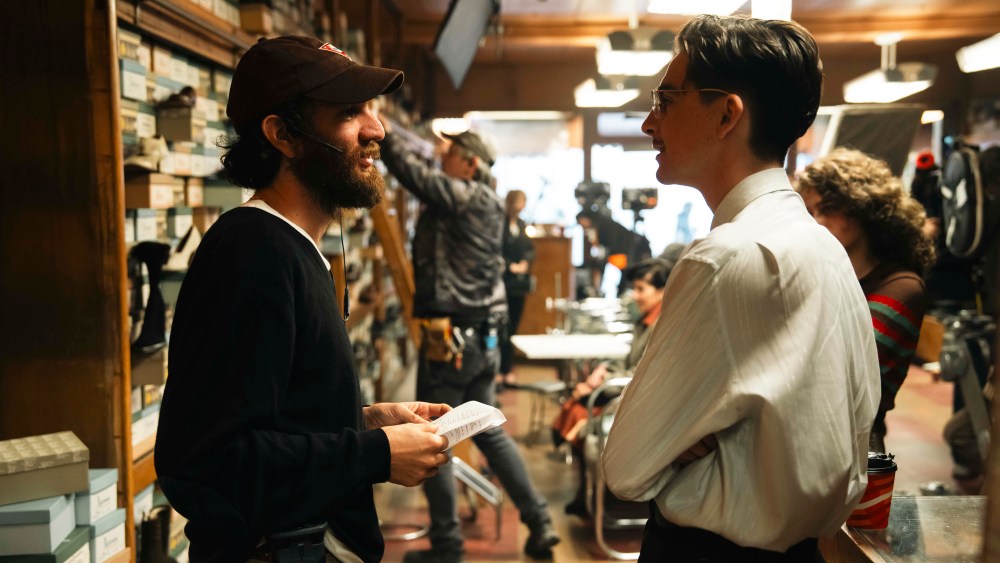
Josh Safdie (right) at the shoe store.
Jun Nishijima
The Shoe Store and 1950s Orchard Street
Fisk lived in New York in the early 1960s, so he knew quite a bit about the proper look. In addition, staff studied New York experimental filmmaker Ken Jacobs’ short film “Orchard Street.” The film depicts the crowds and streets of the Lower East Side in color.
“We actually shot on Orchard Street,” Fisk says. “So we found a store that we wanted to turn into the Northridge Shoe Store, and there was a brand new hotel right next door. So we had problems all over the street. Everyone modernized the building and put in taller plate glass,” he recalls. Additionally, the road signs have changed and there is graffiti everywhere that wasn’t there in the 1950s. Fisk explains that set designers built a modular system of tenement facades that covered the facades of the above-ground buildings.
“Then our decorator, Adam Willis, continued to create layers down the middle of the street, from the modular front awning, to the tables with all the items we were selling, to the storefronts and windows. And it started to look very real.”
“A graphic artist created the signs for us, then a fine artist aged them beautifully, and we used them to hide a lot of modern signs and other unpleasant things underneath.”
“It was fun to be on the streets back then. You could forget yourself and think you were in the 1950s,” Fisk recalls.
The interior of the tenement house was filmed on stage, but the shoe store’s ceiling was falling in and the floor wasn’t safe, so it was filmed in an actual store that had been rebuilt, Fisk recalled. It was important to him to convey a 1950s feel through the colors of the interior.
“Whenever I go to an old place, I try to take it back in time by peeling back the paint and moving the light switches to see what was underneath,” he says. “We use a lot of ’50s color, simply because it was beautiful. If you look at the color charts of the time, there’s very little white, but there’s a lot of very rich color. In my career, I’ve always tried to bring back that color and avoid the plague of white. White seems more modern to me, but it also just punches a hole in the film. When you see white on a piece of celluloid, it’s clear there’s nothing there.”
“Marty Supreme” Table Tennis Japan Tournament.
Tokyo
In the climactic scene, Marty heads to Japan for the championship game. Fisk exchanged drawings and photographs with the Japanese art department for a month before his staff left for Tokyo, and much of the graphics had already been put together.
“We had a plan for how we were going to design the stage where the tournament would be held, but we didn’t know which stage it would be,” Fisk said. After touring filming locations, they discovered a concert shell in a park on the outskirts of Tokyo. “It was perfect. It was so close in time that it was like being in another country. Our staff built some towers out of bamboo and covered them with Japanese graphics.”
“Just a year or two after the movie, I found a photo of some of the artwork from the World Congress in Tokyo and was able to borrow it,” Fisk says.
Safdie, who speaks Japanese, was excited about how the scene came together, Fisk said. “It was a great place to work, the people were very kind, and the art department was very talented. You just wish for something and it becomes reality. The ping pong table was based on an old Japanese table. I sent them a photo of it, and before I knew it, the ping pong table was set up.”
