

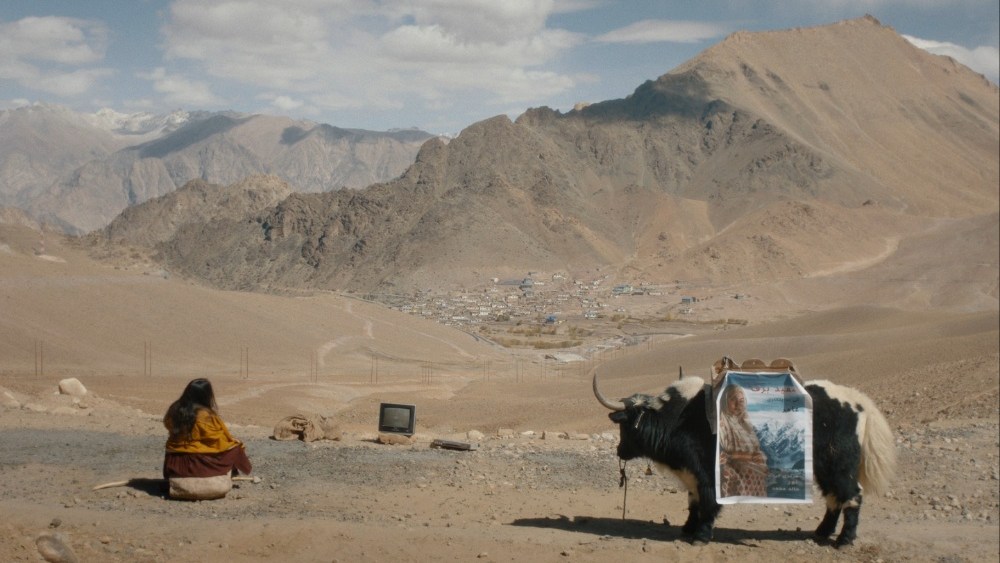
Praveen Morchhale‘s latest feature “White Snow” follows a mother’s arduous trek through Kashmir’s Himalayan peaks to screen her son’s banned film, marking the director’s continued exploration of artistic suppression and human resilience.
The Urdu-language drama, produced by Barefoot Pictures with co-production from France’s Woooz Pictures and associate producers from Germany and Canada, made its world premiere at the Sao Paulo International Film Festival before screening at the International Film Festival of India in Goa. The film is currently playing at the Jogja-Netpac Asian Film Festival, of which the industry component is the JAFF Market.
“White Snow” centers on Fatima, whose filmmaker son Amir sees his work banned after its first community screening following complaints from religious authorities. The film’s transgression: depicting post-partum blood after childbirth. When Amir is arrested on charges of attempting to create social unrest, Fatima embarks on a perilous journey with an old cathode-ray tube television and DVD player loaded onto a yak, determined to screen the film in remote villages.
The production represents an international collaboration, with India, France, Germany and Canada as countries of origin. Mohammad Reza Jahan Panah served as cinematographer, with Anthony Joseph handling editing duties. The cast includes Madhu Kandhari as Fatima, Bhavya Khurana as Ameer, and Noor as Kaneez Fatima.
Morchhale explains that quietness should not be mistaken for passive surrender. “I wanted to explore the profound political power of silence and personal resolve against the oppression of freedom of expression,” he tells Variety. “A mother’s journey is rooted in resistance and love. She does not shout slogans. It becomes subversive precisely because it insists on dignity and freedom of expression in a place and system that thrives on silencing and erasure.”
The director believes small gestures often hold the deepest rebellion. “A mother carrying a banned film silently is a moral force and an act of resistance, I believe it is more enduring than any public outcry,” Morchhale says. “I am drawn to characters who do not shout, but who quietly challenge out of love as well as to preserve what is fundamentally important for their survival.”
Morchhale drew inspiration from a real incident involving an Indian first-time filmmaker whose simple short film about his mother giving birth to him during a snowy night in a taxi was banned for similar reasons. What struck the director most about the real case was how the censorship was implemented. “It was not just the injustice he faced, but how quietly and gradually it was imposed,” Morchhale says. “A slow and calculated action to remove his film from the public sphere and destroy the creative desire of an artist was very hurting and disturbing.”
He notes a troubling trend beyond overt censorship. “I was disturbed and struck by the fear that surrounded artists like him everywhere in the world,” Morchhale observes. “This atmosphere of invisible suffocation is more chilling than overt censorship. Today’s repression often operates not with bans, but through fear, silence, fringe elements and the slow erasure of opportunities.”
The film’s central image of Fatima carrying a cathode-ray television on a yak across the Himalayas operates on multiple levels. “From the very first visual thought of the film, I saw this journey not just as an event or narrative, but as a poetic contradiction,” Morchhale says. “A fragile outdated TV being carried across one of the world’s most enduring landscapes on a yak back becomes a living metaphor.”
For the director, Fatima’s act transcends simple storytelling. “Fatima’s act is also about preserving a memory no one else wants to carry,” he explains. “The yak moves slowly and steady like truth trying to make its way across a disinterested world. The cathode-ray TV irrelevant to modern-day holds a forbidden story and in that, it becomes a symbol of resistance, defiance, and determination.”
Morchhale connects this imagery to the current state of cinema itself. “In a way, cinema today lives under the shadow of fear of disappearance,” he notes. “In the early days of its evolution, cinema journeyed to people. But now, we have arrived at a point where audiences no longer come to the cinema hall. The yak in White Snow becomes a symbol of all of us — the filmmakers and the exhibitors who must carry cinema back to the people.”
The director approached the material with minimal dialogue, instead relying on visual storytelling. “I have always felt that silence is the most honest dialogue and not a weakness,” Morchhale says. “Silence never lies. In ‘White Snow,’ silence became the heartbeat of the film.”
Working with cinematographer Mohammad Reza Jahan Panah, the team constructed what Morchhale calls a visual rhythm. “We used natural light and long takes to create a contemplative space, where emotion could be felt without being explicitly forced,” he explains. “The landscape speaks as a character, the light and its subtle shifts reveal feelings and hurt more than words could.”
The film’s pacing deliberately creates space for audience engagement. “Even the pauses between movement, or the stillness after an action are full of meanings,” Morchhale notes. “In silence, the audience is not directed what to feel. I want them to enter and travel with the life and moment of the characters. And for this togetherness and intimacy, it was imperative to have stillness and pauses so even a small walking sound or heartbeat can be felt as our own.”
Filming in Kashmir’s remote mountain regions presented significant logistical and creative challenges. “Mountain and nature make us realise that we do not control anything,” Morchhale recalls. “The hardest days came when we were filming at high altitude in a remote valley. And these days were endless. The yak, crew, and equipment had to be moved. Aligning ourselves and our visual language with landscape and natural lights was the toughest challenge.”
The environment shaped not just the production but the film’s final form. “These moments taught me something very essential, that we are not in control, and cinema, at least the kind I believe in, must surrender to the natural world,” Morchhale says. “The landscape forced me to rethink pacing and structure. Landscape humbled us, and in that humility, I think the film found its honesty. Film became truthful.”
The film’s title carries particular significance for Morchhale, who describes “White Snow” as reflecting the fragility of memory. “The idea of memory as something delicate like snow that melts when touched but never disappear guided our visual choices,” he explains.
This conceptual framework influenced specific cinematographic decisions. “We framed our characters often at a distance, letting the surroundings dwarf them, emphasising how memory is often swallowed by time and silence,” Morchhale says. “Reflections in mirrors and water distort like a fading memory. We avoided melodrama and let moments linger and dissolve. The light was never overly dramatic like of drifting in memory.”
Throughout Fatima’s journey, she encounters people who attempt to help but face their own limitations in screening the film. “Because real life is rarely about heroes and villains,” Morchhale explains. “In oppressive systems, most people are afraid and submissive. They resign and leave things to fate and become slaves of routine.”
The director chose to portray this systemic helplessness deliberately. “Fatima meets in her journey people who care, who wish things were different, but who also feel powerless to act,” he says. “I wanted to show that silence is often a survival tactic also and not always complicity. This kind of helplessness is more tragic than hatred, because it means even goodness is paralysed.”
The real-life case that inspired the film involved religious leaders objecting to the depiction of postpartum blood. “Censorship is rarely about morality, it is about control,” Morchhale observes. “When a religious leader deems postpartum blood obscene and an official believes it may create revolution, they are not protecting modesty or national interest, they are denying dignity, freedom, and truth.”
For the director, such cases reveal deeper power dynamics. “The act of giving birth becomes offensive only when power fears its own fragility,” he says. “All kinds of censorship fear truth not because it is provocative, but because it cannot be manipulated. Manipulation of emotions is only possible with lies. The most ordinary truth in life — a wound, a cry, postpartum blood — becomes dangerous symbols in such a climate. It shows us how fragile the power system truly is, if a single drop of blood can make it uneasy.”
The film arrives as cinema faces increasing scrutiny and pressure in many regimes. “The air is thick with fear now around the world,” Morchhale says. “Artists feel it even in conversations. I did not begin ‘White Snow’ to make a direct political and religious critique, but I could not avoid the climate we are living in.”
He describes how contemporary anxieties seeped into the film’s texture. “The story came to me, but it brought with it echoes of many real-life incidences I have seen or read about — filmmakers threatened, writers silenced, viewers afraid to speak openly,” Morchhale explains. “All these seeped into the characters in ‘White Snow.’ Their hesitation, their need to whisper, their glances before speaking, all I have seen.”
The film’s international co-production structure proved essential to its realization. “The international support was very important in the journey of ‘White Snow,’” Morchhale says. “These partners believed in artistic freedom, in my kind of cinema I wanted to create. They never asked me to explain the pacing or the creative decision. That trust gave me freedom.”
The backing enabled specific creative choices. “We were able to take our time to shoot in remote locations,” he notes. “Their contribution enabled the film to be more honest and meditative.”
Producers on “White Snow” include Morchhale alongside Jeremie Palanque and Anja Wendell. Additional associate producers include Hecat Studio (France), Anja Wendell (Germany) and Judy Gladstone (Canada).
The physical and emotional toll of the trek gradually affects Fatima’s mental state, with the narrative building toward what Morchhale describes as a transformative conclusion. “I imagined Fatima’s character with respect and dignity,” the director says. “Her descent into hallucination is not madness in the clinical sense, it is a culmination of grief, fatigue, and isolation.”
One particular scene crystallizes this approach. “For example, her one scene in final act projecting the son’s film to her yak is both absurd and sublime,” Morchhale notes. “It is her attempt to reclaim her son’s voice in a world that refused to listen. We allowed her silence to fill the screen with her pain. That restraint was my way of honouring her pain without turning it into spectacle.”
The film concludes with understated power. “And in the last scene, she stands tall and quiet on a bridge over a gusty roaring river as a symbol of her victory and ready to face the repercussion,” Morchhale says. “She does not pronounce her victory aloud and celebrate.”
Morchhale, whose previous features “Widow of Silence” (2018) and “Walking With The Wind” (2017) screened at festivals including Rotterdam, Busan, Sao Paulo and Hamburg, earned National Awards of India recognition in 2018 along with a UNESCO-Gandhi Medal Award. His 2018 Busan International Film Festival selection earned a Kim Ji-seok Award nomination, establishing him as a distinctive voice in contemplative Indian cinema.
“Walking With The Wind” received the ICFTT-UNESCO Gandhi Medal and National Film Awards recognition, while “Widow of Silence” earned the Jury Award at Belgium’s Mooov Film Festival. His most recent feature, “Behind Veils” (2023), took home the INALCO Jury Award at France’s Vesoul Asian Film Festival.
The director positions “White Snow” as a continuation of his artistic journey. “‘White Snow’ is the continuation and perhaps the further refinement of everything I have been working toward,” Morchhale says. “In my earlier films, I was still trying how to listen to silence, how to believe in stillness. With ‘White Snow,’ I felt I am ready to strip away even more, further getting closer to minimalism.”
He describes the film using literary terms. “I wanted the film to feel like a haiku where words are short but infinite in resonance and meaning,” Morchhale explains. “I want to leave the audience to resonate with images and meaning without guiding them. For me, ‘White Snow’ is the most inward personal journey I have made, and also the most universal.”
Maintaining artistic integrity remains central to his practice. “I make films that are fearlessly independent and honest,” Morchhale states. “I protect my integrity by resisting the pressure to entertain at the cost of honesty. Integrity, to me, means telling the truthful story that I strongly believe in.”
He acknowledges the commercial challenges of his approach. “I do not follow trends, markets, or provocations,” the director says. “I am fully aware that I may not reach millions of audience, but if my work touches a few persons deeply, it is enough. It’s not always easy, but it is the only path that feels meaningful to me.”
With “White Snow,” Morchhale continues his exploration of marginalized voices and social injustice through visually poetic narratives. The film’s international co-production structure reflects growing cross-border collaboration in independent Asian cinema, particularly for projects addressing sensitive political and cultural subjects.
Music comes from Nalin Vinayak, with costume design by Ravi Sataliya and production design by Akhilesh Dogne. Sound design was handled by Hossein Mashali and Omid Mohammadipour.
