

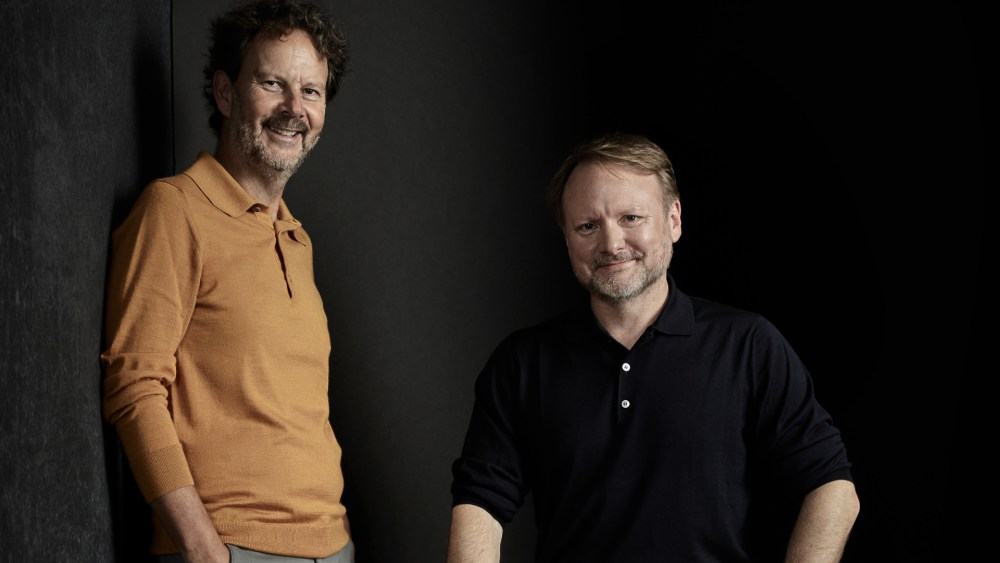
At first glance, T Street Productions doesn’t seem like much. It’s a quiet, repurposed building in West Los Angeles that once housed a music supply store. But within its walls, a small band of fiercely loyal creators is doing something increasingly rare in Hollywood. They’re betting on storytelling for storytelling’s sake.
Founded by director Rian Johnson and producer Ram Bergman, T Street is not your typical film company. The company has no parent company, no studio first-look deals and no brand-building ambitions beyond making original films that connect with audiences. It’s a creative sanctuary designed by filmmakers, for filmmakers, where risks are encouraged, not avoided.
“We never planned on growing for growth’s sake,” Bergman told Variety. “We’re not trying to push this into a studio deal or sell it. We’re about supporting filmmakers. That’s all.”
That spirit has inspired everything from the Oscar-winning American Fiction (2023) to the highly successful Knives Out series. The third film, “Wake Up Dead Man,” opens in theaters this week.
But the real story of T Street lies not just in the movies, but in the people who make them.

Provided by Netflix
Long before “Knives Out” became a pop culture phenomenon, Johnson and Bergman were already self-financing and producing films and building their careers around artistic control. This began as a necessity in Johnson’s debut film, Brick (2005), and later evolved into a principle.
“People told us not to put our money into it,” Bergman said. “But if we’re not willing to bet on ourselves, why should anyone else?”
That mindset gave birth to T-Street in the shadow of “Knives Out.” The first films were independently produced and sold after completion. It was a gamble that paid off. The two-movie sequel deal with Netflix brought in a whopping $450 million in revenue, making it a huge profit. However, that deal has now been finalized and the rights remain with Johnson and Bergman. “It’s still our franchise,” Bergman said.
Johnson was equally uncompromising, declaring that no one else would write or direct the Knives Out movie. “I don’t consider it intellectual property,” he says. “Every ‘Knives Out’ movie is something I want to make. Once that’s gone, I won’t make another one.”
That protective attitude extends to the franchise’s very DNA. Director Johnson made it clear that he didn’t want any characters other than Benoît Blanc to return, ruling out the Avengers-style ensemble reunion that fans had come to expect (and that previous cast members like Kate Hudson had supported). “I love the fact that each of these is a completely unique case and a completely unique mystery,” Johnson claims. “I love actors, and I want to continue working with new actors as well. At the moment, I like the idea of having a new group each time.” It’s a philosophy that keeps each film fresh while ensuring that Johnson remains the sole creative architect.
And while “Wake Up Dead Man” is the final installment of that deal, Johnson says the future of the Benoît Blanc mystery is still unwritten and completely up to them. “We both feel energized from this game,” Johnson says confidently. “When we come up with the next idea, we move on from there.”
Johnson is currently writing the original film, which he hopes to begin shooting in 2026.
The idea for the Benoît Blanc character had been percolating in Johnson’s mind for years. Bergman said Johnson first mentioned the murder mystery concept to his wife, Carina Longworth, on their first date — a full decade before “Knives Out” came to fruition. By early 2017, with the massive Star Wars: The Last Jedi production wrapped and the team down from several thousand people to just a few, Johnson began writing the script for what would be the first film in the series.
While Knives Out was a hit on the big screen, Johnson and Bergman also ventured into television with this week’s murder thriller Poker Face, starring Natasha Lyonne as a casino employee with an uncanny ability to spot lies. The series, which aired on Peacock, garnered critical acclaim and several Emmy nominations. However, despite the success of its critical and devoted fan base, Peacock canceled the show after two seasons. Johnson and producer MRC are considering a new version of Poker Face, with Peter Dinklage replacing Lyonne in the lead role.
T Street’s reputation for secrecy means Hollywood rumor mills often work overtime. If a topic is fairly “quiet”, it can usually lead to wildly off-base speculation. Even before “Wake Up Dead Man” was released in Toronto, rumors that it was “terrible” began to circulate, with some wondering if Johnson would be in serious crisis for the first time. That didn’t happen. In fact, the film currently has a high audience rating of 95% on Rotten Tomatoes. The team is unfazed by all the chatter online, preferring to let their work speak for itself once it reaches an audience.
Netflix
If T Street is a machine, its engines are its producers Nikos Karamigios, Ben LeClair, Leopold Hughes and Katie McNeil. Each one is hand-picked, rigorously tested, and properly executed based on the company’s carefully selected standards.
Although T-Street’s four lead producers came to us through different paths, they not only have worked together for many years, but also share a creative shorthand that comes from a common sense of purpose.
Mr. Leclair, the company’s most senior member, started in a consulting capacity, helping Mr. Bergman and Mr. Johnson formalize a vision that prioritized “quality and uniqueness” over scale. “They didn’t want a traditional company,” he recalls. “We spent a long time discussing what it could be and, more importantly, what it shouldn’t be.”
Hughes, who started as an assistant on Star Wars: The Last Jedi, says he joined the team “almost by accident.” After several years of supporting Johnson through post-production, he was asked to stay on. “There was never any grand plan,” he says. “Just a consistent belief in doing the job and doing it well.”
Newcomer McNeil arrived during the industry’s recent strike. After previously bringing a project to T Street for potential funding, she sought to reconnect, but midway through the conversation, she realized she was being interviewed. “It felt a little surreal,” she says. “Ben introduced me to everyone and started talking about the ethos of the company. Eventually, I had to ask, ‘Wait, is this a job interview?'”
In an age when the word “producer” has become a nebulous title, often as much a bargaining chip as the job description, the T Street foursome maintain a refreshingly down-to-earth perspective.
“There’s no part of this movie that we weren’t involved in,” McNeil said. “You’re in development, you’re in prep, you’re on set, you’re in post, you’re helping with award strategy. A real producer never says, ‘That’s not my job.'”
Karamigios added, “It’s a gap-filling role. You make sure the organism is working. You get things back on track when others can’t or won’t.”
Teams don’t “assign” movies in the usual sense. Instead, producers advocate projects organically based on relationships and intuition. “It’s all about trust,” Leclair says. “If one of us is passionate about a project or a person, we all support it. That’s the model.”
For all the talk about creative control, what sets T-Street apart is its dedicated commitment to supporting filmmakers.
Bergman said Hollywood’s film production system can be fragmented and broken. “One person develops a movie, another person produces it. Filmmakers feel abandoned. We wanted to change that.”
That shift is visible, as directors like Cord Jefferson (American Fiction) and Chloe DeMont (Fair Play) receive full production support, from pre-production to release and awards strategy. “Those successes are not ours,” Bergman asserts. “They belong to our producers and filmmakers. We just gave them the room.”
Most T Street films are cut in-house, with directors touring the site daily. “It’s part school, part studio, part clubhouse,” says Karamyzios. “And filmmakers are feeling it.”
The company does not have the authority to adapt its IP or follow market trends. Instead, they reverse engineer the process. Find a voice worth investing in and build a project around it.
“We don’t look for superhero scripts,” Johnson says. “We’re looking for weird, honest people who have something to say. If that resonates with a large audience? That’s great, but what if it doesn’t? At least we haven’t made something soulless.”
“Wake Up Dead Man” is no exception. Audiences will be eagerly awaiting the return of Daniel Craig’s Benoît Blanc, but Johnson insists the thrill is yet to be discovered. “It’s not about milking the franchise,” he says. “The important thing is to make something good again. The rest is noise.”
Both previous Knives Out films were nominated for Best Picture by the Producers Guild of America, and Johnson received Oscar nominations for his original screenplay for the first film and for his adaptation of The Glass Onion.
For companies defined by the constraints of producing only a few projects a year, the impact is enormous.
“We learned that we could make a living making the movies we wanted to make,” Bergman says. “That’s what it’s all about. We own our schedules. We own our offices. We even own our buildings. That freedom is the real achievement here.”
That autonomy and camaraderie is something Johnson doesn’t take for granted.
“It’s rare to have a partner you can trust 100 percent,” he said, nodding to Bergman. “That’s the biggest blessing in this business.”
“Wake Up Dead Man” will be released in theaters on November 26th and will debut on the Netflix platform on December 12th.
