

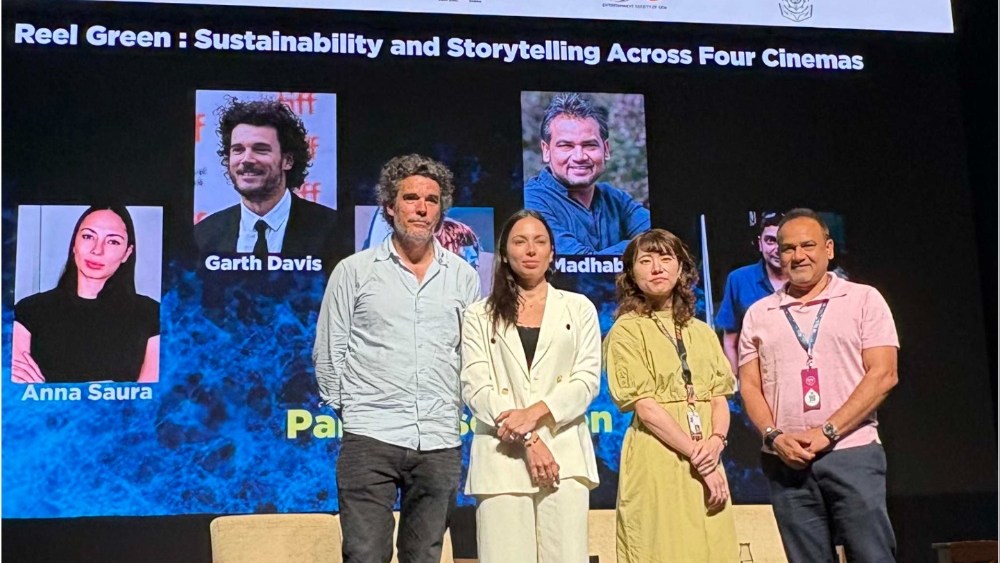
Sustainability in filmmaking is not progressing fast enough, and real progress requires structural reform, cultural change and mandatory standards – that was the frank consensus from filmmakers from Japan, Spain, Australia and India at the Indian International Film Festival’s ‘Reel Green’ panel.
Curated by Gori Nair, Head of Masterclass and National Film Festival Programming, and moderated by Variety’s Naman Ramachandran, the panel featured producers Mina Moteki (Japan) and Anna Saura (Spain), directors Garth Davis (Australia) and Nila Madhav Panda (India). Across their different contexts, filmmakers agreed that meaningful environmental progress in the film industry will need to come from deep cultural change, not just practical reforms and ambition from the top.
The IFFI panel examined how each country’s industry, each shaped by its own traditions, pressures and protocols, is transitioning to greener and more responsible film production or still struggling to implement mandated sustainable practices.
Garth Davis, the Oscar-nominated director of Lion, linked the challenge of sustainability to a broader moral and relational crisis. “The state of the earth reflects our state and our relationship,” he said. His filmmaking aims to “remind people of respect and kindness” and incorporates environmental awareness into the story itself. Davis described early commercial work where the team voluntarily added a carbon tax to the budget to fund offsets. This was a small step that laid the foundation for a larger systemic idea. He also warned of a rapid increase in energy demand due to AI and urged investors to take a long-term view to ensure data centers are powered by green energy.
Mina Moteki, a producer at Kowatanda Films (Japan’s Kowatanda Films), explained how sustainable practices clash with Japan’s deep-rooted production traditions, such as printed scripts and long working hours. He stressed that before Japan can meaningfully transition to greener production, the industry must first address workplace health. “Before we can think about going green, we need to have a healthier workplace for our staff and cast.”
Moteki also noted Japan’s contrasting environmental burdens in anime and live-action production, now a $25 billion industry. He stressed that cultural and labor reforms must be given top priority, although the impact will vary. In fact, she and other independents rely on digital documentation, local staff, public transportation, and minimal set-up to reduce waste. She acknowledged the need for Japan to learn from its global peers and expressed a personal obligation to “spread knowledge so we can move forward.”
Anna Saura, a Spanish film and documentary producer, gave an example of what structural changes embedded in national policy could look like. Spain requires publicly funded productions to comply with sustainability protocols and obtain certification. “If you don’t get this certificate, you can’t receive the money,” she said. She also emphasized the importance of training film students so that sustainability is as fundamental as lighting and direction.
Asked if sustainable practices would improve the art of filmmaking, Saura said: “I don’t know if it’s improving the industry, but it can help the world.” She acknowledged that green equipment and certifications can be costly, especially for low-budget productions, but argued that sustainability must become a standard requirement, a basic expectation rather than an add-on. “I think we’re at the very beginning of a new era of sustainability in the film industry, which is why it’s so important,” she said.
Nila Madhav Panda, an Indian film director known for films focused on climate change, called the industry’s waste output “insane” and pressed for accountability. “This is a business of creativity. We may not be able to compromise on that, but we could also have a creative sustainability director who raises awareness from day one and looks at green practices from budgeting and pre-production,” he said, suggesting the introduction of a sustainable carbon incentive by the government. “We should start labeling films with carbon information from the beginning,” he added, adding that sustainable practices often boost morale by creating a “guilt-free” working environment.
Davis agreed, adding that sustainable habits have created a “general increase in energy and optimism,” and that crews are now approaching growers with suggestions for reducing their footprint, from cycling to sets to installing solar-powered rigs. “I’m really motivated,” he said.
The panel also considered strategies for reusing sets, props, and food. Davis described discussions in Australia about copyright and preventing the destruction of sets kept for reshoots. Moteki outlined indie practices such as using natural spaces, donating costumes, and distributing surplus lunch boxes to avoid food waste. Saura pointed out that renting, rather than building, is the norm in Spain, with post-shoot markets where crew members can buy and take home wardrobes and props.
Panelists across the region agreed that sustainability requires cultural changes, stronger work structures, mandatory guidelines and daily practices. The message was clear. As Saura said, the industry is still “at the beginning of a new era,” but with knowledge sharing and structural reforms, sustainable filmmaking can set the standard for environmental responsibility.
