

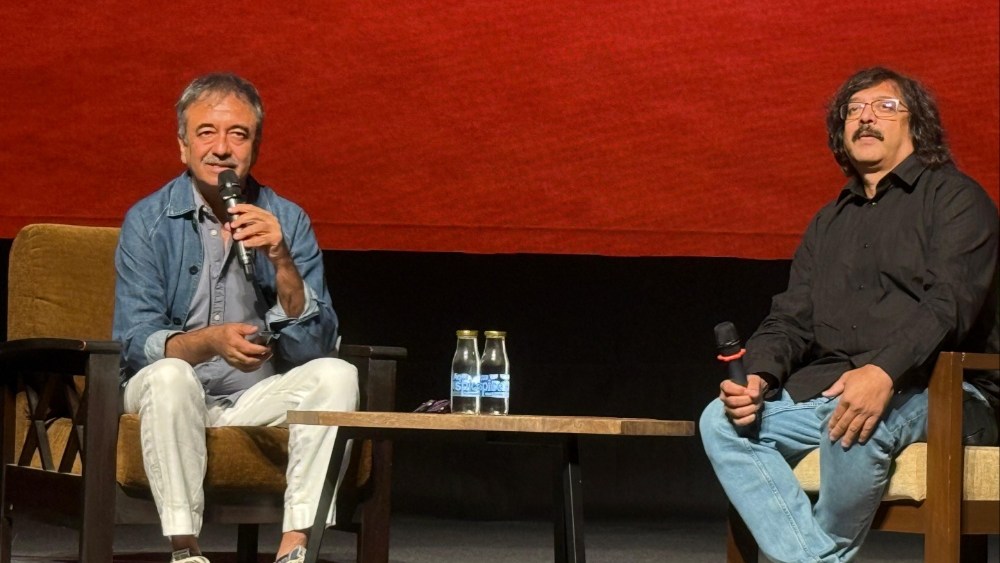
India’s leading film director Rajkumar Hirani drew a packed house at the International Film Festival of India (IFFI) with a dynamic session that used examples from “3 Idiots,” “Lage Raho Munna Bhai,” and his extensive filmography to show how meaning, tension, and character can be completely transformed by the placement of shots, sounds, and structures.
With long-time collaborator Abhijat Joshi, he explored the idea that writing is an imagined emotion, whereas editing is an experienced emotion, and argued that conflict remains at the heart of film storytelling.
“A good editor plays with the emotions,” he said, referring to American director D.W. Griffith. “Sometimes magic happens during editing.”
While editing, Hirani said, “Editing can really change the meaning of a story. And how does that happen? When you write something, the unit of writing is the word, many words make sentences, and sentences make paragraphs, chapters, and finally books. Similarly, the unit of editing is the shot. The unit of editing is the shot. The body may not contain all the meaning, but when combined with many other shots, new meanings emerge. Now imagine that you can change the shot, or even reverse the shot. If you take the sound from here and put it somewhere else, the movie will have it. There are 10,000 shots that can completely change from what you actually intended.
Hirani and Joshi talked about their process, which begins with the concept that “writing is an emotion that is imagined,” while being edited is an “emotion that is experienced.” According to them, a movie begins when a character “wants” something, conflict is the “oxygen”, and explanation must be hidden under the drama and conflict.
“Conflict is not something to be welcomed in life. But in movies, without conflict, things get boring very quickly. Conflict is the heart of a movie,” Joshi said, adding that the strongest drama is created when two legitimate, contradictory truths collide.
Hirani urged writers to base their stories on lived experiences. “A good writer has to choose a trigger from life,” he said.
